
Energy Evolution in the Age of AI:
Lessons from a Turbulent 2025
As 2025 draws to a close, let's be honest: it was anything but boring. From Trump's tariffs to breakthroughs in AI and China's relentless rise as a global superpower –and de facto leader of the energy transition – all set against an increasingly complex and volatile geopolitical landscape.
Energy Evolution in the Age of AI:
Lessons from a Turbulent 2025
As 2025 draws to a close, let's be honest: it was anything but boring. From Trump's tariffs to breakthroughs in AI and China's relentless rise as a global superpower –and de facto leader of the energy transition – all set against an increasingly complex and volatile geopolitical landscape.
My personal AI awakening

For me, personally, the biggest shift in 2025 was discovering I now have a tireless, extremely clever assistant living in my phone. Unfortunately, I don’t get any tech cred from my teenage children – they still see me as a laggard, joining the bandwagon at least a year after they did.
Nevertheless, I am blown away by the transformational change AI is already bringing to our lives, and this will only accelerate. According to recent surveys, only around 50% of people in OECD countries are using AI in their everyday lives. That means more than three-quarters of the planet hasn't really started yet. We better buckle up.
The battle for AI supremacy – and its energy hunger
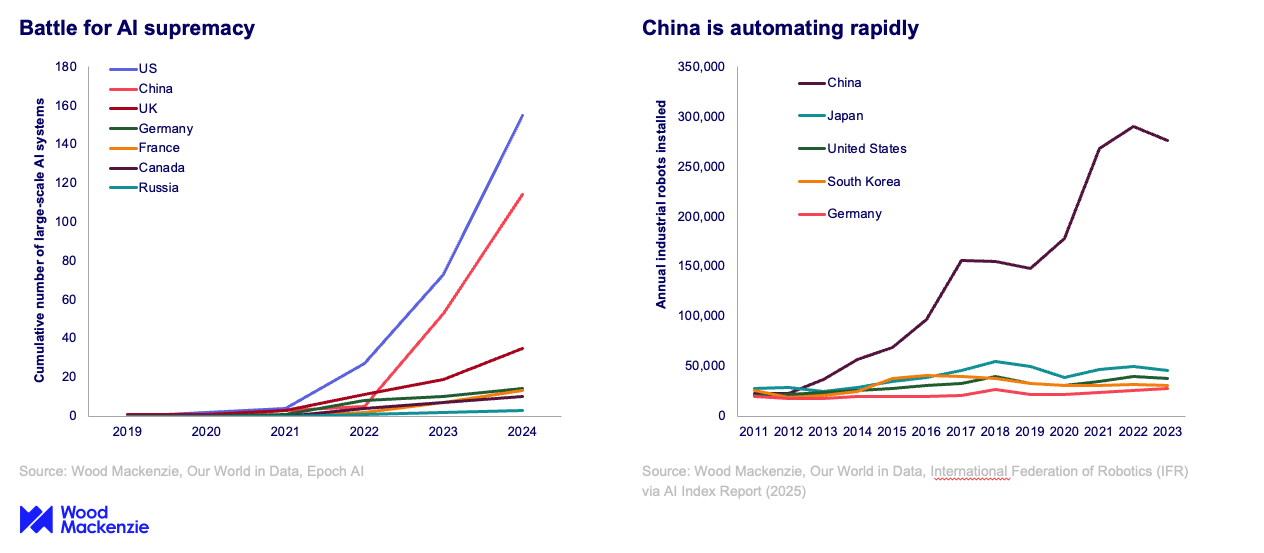
The growth of AI and data centres globally has been front and centre in debates on energy demand growth. The US is leading the global race, with China a close second. Everyone else is miles behind.
What really grabs attention is the difference in approach between the two superpowers. In China, around 80% of AI development focuses on robotics, supercharging its already dominant manufacturing sector.
Imagine the implications: China is the global leader in manufacturing. With AI-driven automation delivering German-level quality at superb low-cost efficiency, that gap could widen dramatically – perhaps becoming unbridgeable.
But this AI boom is straining global power markets. At Wood Mackenzie, we're tracking over 250 GW of data centre projects – more than triple last year. Global data centre power demand is projected to reach 700 TWh in 2025, exceeding that of electric vehicles. By 2050, it could hit 3,500 TWh – equivalent to the current power demand of India and the Middle East combined.
This surge risks electricity crises, higher tariffs, and grid bottlenecks. In our base case, we expect the global electricity market to expand by a fifth by 2030 and double by 2050.
Yet there's a real danger we're creating a bubble by overestimating this demand. The emergence of DeepSeek earlier this year – a highly efficient Chinese AI startup – perfectly illustrates the risk. Breakthroughs in efficiency could dramatically reduce the power needed for cutting-edge AI, leaving overbuilt infrastructure in their wake.
Geopolitical pressures and the slowing western push on climate
There is no doubt that the global push to tackle climate change has slowed. Ten years after the Paris Climate Agreement, no major developed country appears on track to meet their 2030 emissions reduction targets. It is now widely acknowledged that the world will not achieve net zero emissions by 2050.
Wood Mackenzie's latest base case puts the world on a 2.6°C pathway—worse than our prediction a year ago.
Why the stall? Geopolitical and economic headwinds – from wars in Ukraine and the Middle East to unpredictable tariffs – have created barriers. Rising populations, economic growth, and societal aspirations in developing countries are driving energy demand higher, outpacing efficiency gains.
In recent months, many developed nations have prioritised affordable, secure energy over sustainability goals. The US withdrawal from the Paris Agreement sent a clear signal, reinforced by the 2025 National Security Strategy: "We reject the disastrous ‘climate change’ and ‘net zero’ ideologies that have so greatly harmed Europe, threaten the United States, and subsidize our adversaries."
US banks have exited the Net Zero Banking Alliance, joined by some European ones. Many corporates have diluted climate ambitions to focus on shareholder returns.
The pendulum has swung back.
Why did it swing so far – and what next?
We allowed the energy transition to become deeply politicised – a battle between climate evangelists and deniers. We failed to frame it as a non-partisan, pragmatic global initiative. We didn't even try to bring the other side on board. In pursuing the perfect, we risked defeating the good.
The lesson? Compromise. Make deals. That might mean tempering lofty net zero ambitions, but it could secure real progress on technologies on the cusp of "escape velocity."
Because the energy transition is happening – just not where many expected. It's happening in China, which never obsessed over emissions targets. Instead, Beijing focused on solving the energy trilemma by delivering on security of supply and affordability first, with sustainability emerging as a by-product.
As a recent Economist article put it: "The scale of the renewables revolution in China is almost too vast for the human mind to grasp. China is now making more money from exporting green technology than America makes from exporting fossil fuels."
China's green tech exports will grow exponentially across the developing world. The more the West tries to decouple from China-dominated supply chains, the deeper Beijing will penetrate growth markets in Africa, South Asia, and Southeast Asia.
A pragmatic path forward
Looking at the Western approach, we didn't quite get this right. It's time to correct course.
We cannot quickly swap a fossil fuel-based system for a low-carbon one overnight. That doesn't mean renewables aren't vital – we should celebrate their rise from 5% to 20% of global power supply over the past decade. But that growth barely covered incremental demand.
At Wood Mackenzie, we foresee an "energy evolution": fossil fuels as the bedrock for decades, complemented by low-carbon fuels gaining share to meet surging demand. The future system will be more interconnected, complex, and volatile – requiring careful capital allocation and fine-tuned policy.
As we reflect on 2025, the world feels complicated. The transition is messy – slower in some places, faster in others, and rarely as predicted.
We will keep making mistakes – that's what humans do when tackling something unprecedented at this scale. But we should take pride in the energy industry's huge achievements: the engineers, scientists, traders and leaders who keep the lights on and push boundaries every day.
Pushing for change was never going to be easy. As Heraclitus said, this world "was ever, is now, and ever shall be an ever-living fire, with measures of it kindling, and measures going out."
In energy, that fire burns brighter than ever – pragmatically, relentlessly, and with human ingenuity at its core.
Here's to a 2026 built on compromise, courage, and steady progress.
By Valentina Kretzschmar,
VP Consulting, Energy Transition Management,
Upstream Carbon Management,
Wood Mackenzie